Factional unrest in the Blazing-World
The Blazing WorldFactional unrest in the Blazing-World is the crisis that exposes the fragility of the Empress’s political order: once peaceful and unified, it has become unsettled by disputes among its learned societies and by changes to its original government. The Duchess diagnoses the unrest as more than an argument among scholars; it is a danger to the state, and her remedy is a return to centralized rule and institutional uniformity.
Origins of the Unrest
When the Empress first assumed power, the world was, by her account, governed well and quietly. After she received absolute authority from the Emperor, however, she changed the form of government she had inherited. She later tells the Duchess that the world is no longer as peaceful as it was before, and that she fears its divisions may end in open rebellion and the ruin of government.
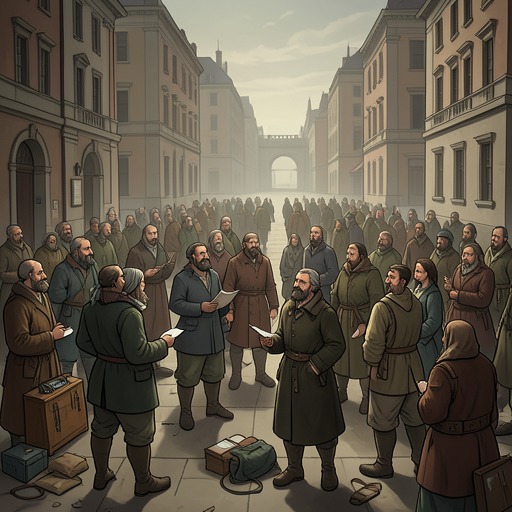
The conflict is concentrated among the Worm-men, Bear-men, Fly-men, Ape-men, Satyrs, Spider-men, and other groups. Their repeated contentions and divisions are not described as an armed revolt already underway: the Empress fears that they will break out into one. The threat lies in the movement from persistent scholarly conflict to factional disorder and then, potentially, political violence.
Institutions and Sources of Division
The Empress had encouraged the different kinds of inhabitants to pursue professions suited to their species, establishing schools and learned societies for their work. That arrangement produced specialized bodies of investigators, but it also gave disputes a durable institutional home. In an earlier confrontation, the Bear-men defended their telescopes by arguing that they preferred artificial delusions to natural truths: without uncertainty, they would have no occasion to dispute or contradict one another. The Empress allowed them to keep the instruments only on condition that their quarrels remain inside their schools and do not disturb the state. The later unrest shows how difficult that boundary has become to maintain.
The Duchess explains that learning commonly brings controversy because people seek to know more and appear wiser than others. Some believe their arguments approach truth more closely; others cling to opinions rather than yield, even when those opinions lack a firm rational basis. Fear of disgrace can make people defend a position they no longer consider reasonable. In the Duchess’s account, such rivalries first produce factions within schools, but may eventually become open conflict and bring a state or government to ruin.
The crisis also throws the world’s proclaimed unity into sharper relief. Its statesmen had defended monarchy by comparing a commonwealth with many governors to a body with many heads, and by linking one Emperor to worship of one God. Its priests likewise described a single shared religion and a common form of prayer. Yet the existence of separate churches for different groups and the Empress’s later conversion program complicate any simple equation of formal unity with social harmony.
The Duchess’s Diagnosis and Proposed Remedy
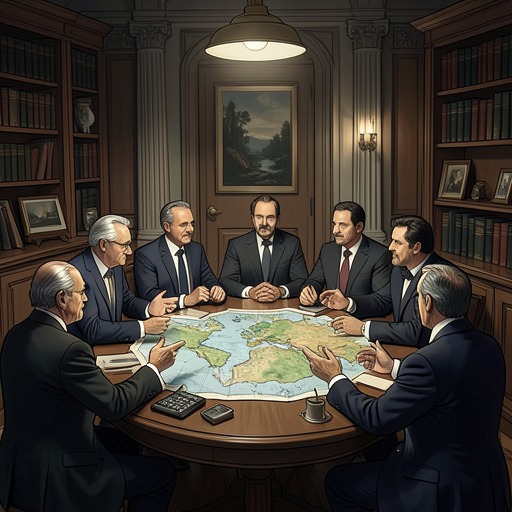
The Duchess advises the Empress to restore the government that had existed before her changes: one sovereign, one religion, one law, and one language. She imagines the whole world as a single united family, without divisions. Her warning contrasts that ideal with her own home world, which she describes as burdened by competing sovereigns, religions, opinions, laws, ambitions, languages, controversies, and partial distributions of gifts. The contrast makes political fragmentation appear not as a mere inconvenience but as a condition in which authority and justice lose coherence.
Her recommendation is not limited to restoring a constitutional arrangement. Because the Empress specifically complains of the societies’ factions and perpetual disputes, the Duchess also advises dissolving them. In her view, losing their intelligence is preferable to keeping institutions that make government unquiet and disorderly. The proposal treats learned inquiry as both useful and politically hazardous: its knowledge may benefit the sovereign, but the competition it sustains can threaten the state.
Resolution and Political Significance
The Empress says that she is willing to follow the Duchess’s advice but worries that reversing her own decrees, acts, and laws would bring her lasting disgrace. The Duchess reframes revision as evidence of wisdom and goodness: a ruler who recognizes an error and does not persist in it deserves honor rather than shame. The exchange presents political reform as a test of sovereignty—not simply whether the Empress has the power to impose order, but whether she can acknowledge that her own decisions contributed to disorder.
The episode leaves a tension at the center of the Blazing-World’s ideal of peace. Its unity is defended through concentrated authority, a single faith, and limits on institutional difference; the proposed cure for faction is to eliminate the societies that generate disputation. At the same time, the Empress’s earlier concession to the Bear-men had protected their debates so long as they stayed within their schools. The crisis therefore marks the pressure point between intellectual contest and political stability: disagreement is tolerated as a contained pleasure until it appears capable of becoming a rival source of allegiance and power.